
01
Get the app
Search "Alipay" in your app store — blue icon, white 支付宝 characters. It's the same app everyone in China uses. Once you're in, switch it to English under Me → Settings → Language.

HowToCN — China, made easy for travelers
You just landed. Everyone pays with their phone. This guide takes you from download to paying for noodles in about 15 minutes — written from real trial and error, not the app store description.
01
Before the how, the why. Three things I wish someone had told me on day one.
Cash is still legal, but small vendors often can't break a ¥100 note, and some counters are effectively mobile-only. Your phone is the path of least resistance.
No Chinese bank account needed. Link the Visa or Mastercard you already have, verify with your passport, and you're in.
Street food, taxis, subway, museums, convenience stores — if money changes hands in China, Alipay is probably accepted.
02
Takes about 15 minutes. You'll need your passport, your phone, and a Visa or Mastercard from home. Do this at the hotel on day one — not at a checkout counter.
01
Search "Alipay" in your app store — blue icon, white 支付宝 characters. It's the same app everyone in China uses. Once you're in, switch it to English under Me → Settings → Language.
02
Use your foreign number — you'll get an SMS verification code. No Chinese number needed, and the code usually arrives within a minute.
03
Go to Me → Bank Cards → the + button. Visa, Mastercard and JCB all work. You might see a tiny test charge from Alipay — that's just the card check, it disappears.
04
This is the step people skip, then regret. Go to Me → Settings → Account and Security → Identity Verification. Scan your passport and take a quick selfie. This lifts you from pocket-money limits to the real $50,000-per-year foreign-card allowance. It can take a few hours to approve, so don't leave it until you need it.
05
A 6-digit PIN you'll type — or confirm with Face ID — every time you pay. Pick something you won't blank on at a noodle stall.
03
Two ways to pay, and a short list of things that look payable but aren't — at least not with a foreign card.
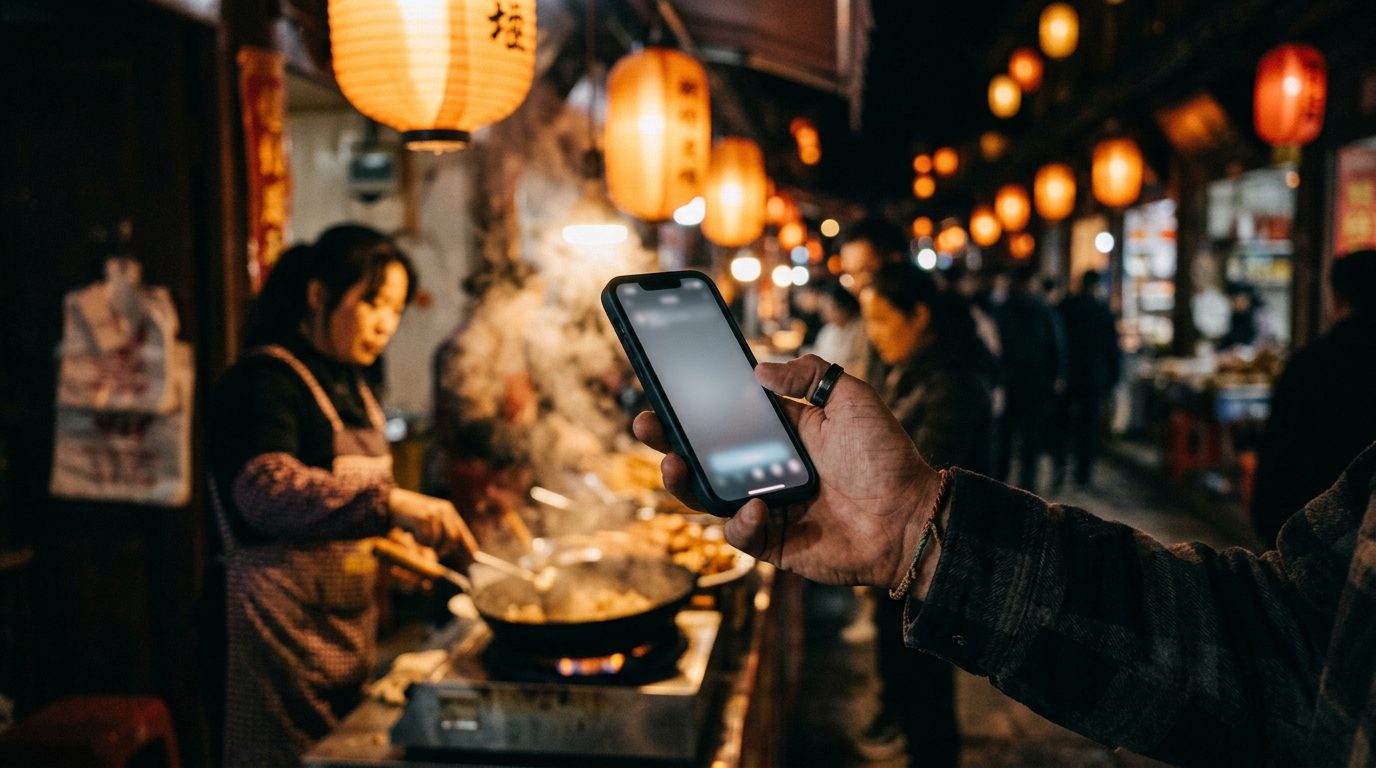
The everyday stuff. This is 95% of your life in China.
WORKS
The printed QR on the counter — open Alipay → Scan. Malls, restaurants, convenience stores, most street vendors. If it scans, it pays.
WORKS
Pay/收付款 → let them scan you. Fastest at supermarkets and chain stores — you barely break stride.
WORKS
Most vendors have a printed merchant QR taped to the cart or counter. Works the same as anywhere else.
These fail silently or with a cryptic error. Now you know why.
FAILS
Scanning a friend's personal QR to "pay" them is actually a transfer — and foreign cards can't do transfers. This is the #1 "why did it fail" I hear about.
LOCKED
Adding money to your Alipay balance is locked for foreign cards. Don't plan around it — just pay directly from your linked card.
LOCKED
Hongbao, wealth products, splitting bills with wallet money — all of these need a Chinese bank card. Skip them entirely.
SOMETIMES
A few in-app mini-programs block foreign cards at checkout. If one fails, pay the merchant directly instead of through the mini-program.
04
Collected from real messages and comments since 2024. This is the stuff the official help pages don't tell you.

LIMIT
Once you're passport-verified, foreign cards are capped at $50,000 USD per calendar year. The counter resets every January 1. Tourists will never touch it — but if you're staying long-term, plan around it.
MYTH
This number floats around expat forums, but someone paid ¥36,000 in a single swipe and it went through fine. The real blocker is usually the merchant: if the shop never enabled foreign-card acceptance, your payment fails no matter what you do.
TRAP
That QR your friend sent for their share of dinner? Scanning it fails — because it's a transfer, not a purchase, and foreign cards can't do transfers. Ask for their merchant code instead, or just cover the bill and settle up later.
TIMING
Passport verification can take a few hours to come back. Do it at the hotel on day one with good lighting — not at the checkout counter with a line behind you.
CASH
Cash is legal and accepted, but small vendors often can't break large notes. This is honestly the most practical argument for getting Alipay working.
APP
If you switch phones mid-trip, log back in with the same phone number — don't create a second account. A fresh account starts unverified, with tiny limits, and you'll wonder why everything broke.
Tell me what happened via the feedback form — I read every message and update these guides.
05
The questions I get asked most. Short answers, no fluff.
No. Sign up with your foreign number — the SMS code arrives just fine.
No. Link the Visa, Mastercard or JCB you already have. That's the whole point of the international version.
Yes. Go to Me → Settings → Language → English. Most of the core payment flow translates cleanly; a few deep settings pages may still show Chinese.
First, check the usual suspects: unverified identity, a personal QR instead of a merchant code, or the shop never enabling foreign cards. Ask the staff "可以用外卡吗?" — if they shake their head, pay cash or try the next shop.
Not really. Alipay isn't an ATM for foreign cards. Bring some cash for backup, or use your physical card at a bank ATM.
Alipay is run by Ant Group and processes an absurd volume of transactions daily. Your card details stay with Alipay — merchants never see them. Just make sure you download the official app, not a lookalike.
Mainland China is where this guide applies. Hong Kong has its own AlipayHK app with different rules — don't mix them up.
New guides and app changes that actually affect you. No spam, unsubscribe anytime.
Tell me what happened — I read every message and update these guides.
WeChat DiDi Meituan eSIM & VPN Chengdu city guide Chongqing city guide